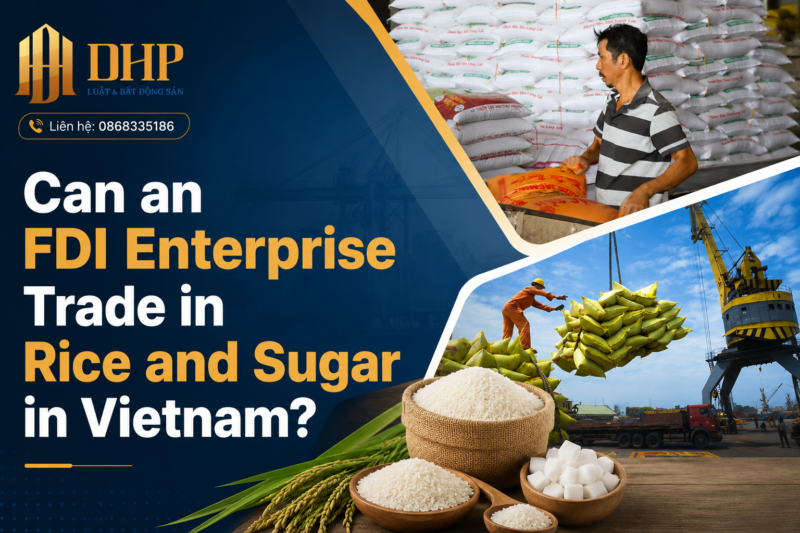
Can an FDI Enterprise Trade in Rice and Sugar in Vietnam?
Question:
In the field of investment, I have heard the term “FDI enterprise” many times. Therefore, I would like to better understand what an “FDI enterprise” is. Under Vietnamese law, is an FDI enterprise permitted to trade in rice and sugar in Vietnam?
Lawyer’s Answer:
Legal grounds applicable to this matter
The legal bases for resolving this issue include:
- International treaties to which Vietnam is a party, such as Vietnam’s WTO Commitments and the EU–Vietnam Free Trade Agreement (EVFTA);
- Circular No. 34/2013/TT-BCT;
- Circular No. 31/2022/TT-BTC; and
- Clause 4, Article 9 of Decree No. 09/2018/ND-CP.
What is an FDI enterprise?
An FDI enterprise is an enterprise with foreign direct investment capital, regardless of the specific percentage of foreign ownership.
Currently, there are two main types of FDI enterprises:
- Wholly foreign-owned enterprises;
- Joint venture enterprises between domestic and foreign investors.
Example: Kimberly-Clark Vietnam Co., Ltd. (KCV) is a wholly foreign-owned enterprise, owned by Kimberly-Clark Worldwide. The company entered the Vietnamese market to supply products such as Huggies diapers, Huggies tissues, Kotex products, and other consumer goods.
What goods may FDI enterprises export, import, and distribute?
Under Article 2 of Circular No. 34/2013/TT-BCT, foreign-invested enterprises are permitted to trade in goods as follows:
1. Export rights:
FDI enterprises may export goods except for those listed in Appendix 01 of Circular No. 34/2013/TT-BCT.
The category of goods that may not be exported includes:
- Crude petroleum oils and oils obtained from bituminous minerals, in crude form.
2. Import rights:
FDI enterprises may import goods except for those listed in Appendix 02 of Circular No. 34/2013/TT-BCT.
The categories of goods that may not be imported include:
- Cigars, cheroots, cigarillos and cigarettes made from tobacco or tobacco substitutes;
- Processed tobacco leaves and other processed tobacco substitutes; “homogenized” or “reconstituted” tobacco; tobacco extracts and essences;
- Petroleum oils and oils obtained from bituminous minerals, other than crude; preparations not elsewhere specified or included, containing by weight 70% or more of petroleum oils or oils obtained from bituminous minerals, where such oils are the basic constituents of the preparations; waste oils;
- Newspapers, specialized journals and periodicals, whether or not illustrated or containing advertising material;
- Discs, tapes and other recorded media for sound or similar recordings, including masters and matrices for the production of tapes and discs;
- Other aircraft (for example, helicopters and airplanes); spacecraft (including satellites) and spacecraft launch vehicles;
- Parts of goods under heading 88.01 or 88.02. The corresponding HS codes may be consulted in the Appendix to Circular No. 31/2022/TT-BTC.
3. Distribution rights:
FDI enterprises may distribute goods except for those listed in Appendix 03 of Circular No. 34/2013/TT-BCT.
The categories of goods for which distribution rights are not granted include:
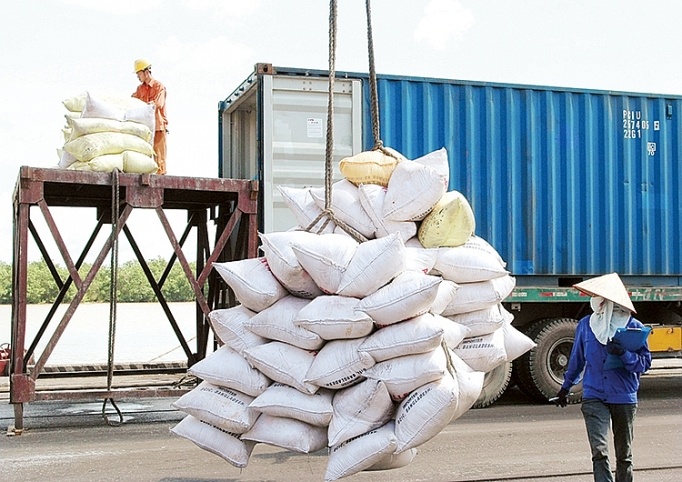
- Rice
- Cane sugar and beet sugar
- Tobacco and cigars
- Crude oil and processed oil
- Pharmaceuticals
- Explosives
- Books, newspapers and magazines
- Precious metals and gemstones
- Recorded audiovisual materials in any medium
Legal regulations on FDI enterprises trading in rice and sugar in Vietnam:
Foreign-invested enterprises are not permitted to exercise export, import or distribution rights for goods that fall within the lists of goods excluded from export, import or distribution rights under Circular No. 34/2013/TT-BCT.
In addition, under Vietnam’s WTO Schedule of Commitments, Vietnam has not committed to opening the market for the distribution of rice and sugar in Vietnam.
However, under Clause 4, Article 9 of Decree No. 09/2018/ND-CP, although these goods are not covered by Vietnam’s market-opening commitments under international treaties, foreign investors may still be permitted to carry out retail distribution rights if they already operate retail outlets (such as supermarkets, mini-supermarkets, or convenience stores) and obtain the relevant approvals. Therefore, FDI enterprises wishing to trade in rice and sugar in Vietnam must obtain approval from the Ministry of Industry and Trade before they are allowed to distribute such goods.

So, can an FDI enterprise trade in rice and sugar in Vietnam?
Based on the above analysis, it can be concluded that FDI enterprises may trade in rice and sugar in Vietnam within the limits prescribed by law.
Foreign-invested companies are only permitted to trade in these products through supermarkets, mini-supermarkets, or convenience stores. In addition, the enterprise must obtain the approval of the Ministry of Industry and Trade and be granted the relevant business license before it may legally conduct such trading activities.
See also: What Is the capital contribution ratio of a foreign investor in an existing enterprise in Vietnam?
Contact us for legal advice and assistance
DHP LAW FIRM
Head Office: The Manor 2 Building, 91 Nguyen Huu Canh Street, Binh Thanh District, Ho Chi Minh City, Vietnam
Hanoi Office: Villa VA03A – 9 Hoang Thanh Villa, Ha Dong District, Hanoi, Vietnam
Phu Quoc Office: 25 Hung Vuong Street, Duong Dong Ward, Phu Quoc City, Kien Giang Province, Vietnam
Southwest Mekong Delta Office: 42 Nguyen Thi Minh Khai Street, Ward 5, Bac Lieu City, Bac Lieu Province, Vietnam
Hotline: 0868 335 186
Email: luatdhp@gmail.com
Website: dhplaw.vn
Facebook: Facebook/Luatdhp